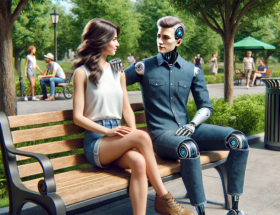
It’s easy to imagine the year 2100 as a place filled with advanced technology. Smarter machines. Faster systems. Fewer limits.
But what’s harder — and more interesting — is imagining how it will feel to be human then.
Not what we’ll have.
But what we’ll need.
By 2100, speed will likely be abundant. Information instant. Decisions assisted. Friction reduced. Many of the inconveniences that once shaped daily life may be quietly engineered away.
And yet, wellbeing has rarely been about convenience alone.
When Everything Is Available
If almost anything can be accessed instantly — answers, entertainment, connection — then patience may become unfamiliar. Waiting, once a shared human experience, could feel unnecessary or even uncomfortable.
Attention might be the real scarcity.
Not because information is hidden, but because there is simply too much of it.
The challenge may not be keeping up, but choosing what to ignore.

The Quiet Challenges
Loneliness could look different in 2100. Not fewer connections, but shallower ones. A sense of being seen, measured, tracked — yet still not fully known.
When life becomes optimised, moments that don’t serve a clear purpose may quietly disappear. Boredom. Wandering. Unstructured time. The small pauses where thoughts used to surface on their own.
Wellbeing may hinge less on survival and more on meaning.
The Old Things That Might Matter More
Some comforts may feel surprisingly old-fashioned.
Walking, without destination or data.
Making something by hand, slowly.
Sitting with others, unmediated.
Eating together, without distraction.
Silence — not as absence, but as relief.
Nature will not become obsolete. If anything, it may feel more precious. Not as spectacle, but as grounding. A reminder that not everything responds instantly.

What Being Human Might Mean
Being human in 2100 may involve relearning boundaries. Choosing slowness where speed is default. Protecting inner life in a world that knows how to stimulate but not always how to soothe.
Wellbeing might depend less on what technology can do for us, and more on what we decide to preserve.
Because no matter how advanced the future becomes, the basic needs may remain unchanged:
to belong, to rest, to be present, and to feel that life is more than a sequence of optimised moments.
In that sense, the future of wellbeing may look surprisingly familiar.
And perhaps that’s reassuring.
I wrote recently about the importance of switching off in a world that never stops — a thought that feels just as relevant when imagining the future.
— GertieBlu