There’s a moment that happens quietly.
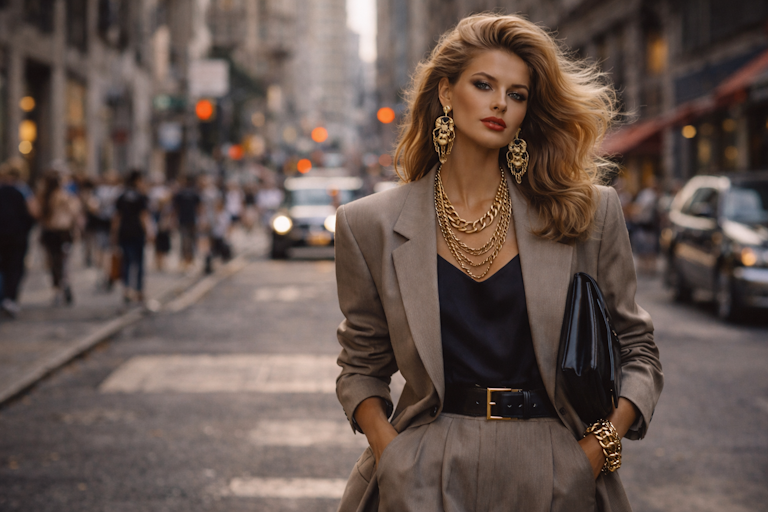
You’re walking down a street — maybe London, maybe Berlin, maybe somewhere warmer where linen moves in the breeze — and you see someone pass in an oversized blazer, loose trousers, retro trainers. The silhouette is unmistakable. Not costume. Not parody. Just… familiar.
You realise you’ve seen it before. In old photographs or in a music video from decades ago.
And you wonder:
Why does fashion revisit us from the past?
The 30–40 Year Nostalgia Rule
Fashion moves in waves, but those waves have rhythm. Roughly every thirty to forty years, an era returns — not as an exact replica, but as a reinterpretation.
The generation of one decade grows up to become designers, stylists, editors, brand directors. They begin shaping culture. And subconsciously, they reach back toward the imagery that surrounded them when the world felt large and possibility felt infinite.
Psychologists call it rosy retrospection — we remember the glow, not the awkwardness. The bold shoulders of the 1980s, the cool restraint of the 1990s, the gloss of the early 2000s — each becomes softened by time.
Fashion doesn’t just revive old clothes.
It revives old feelings.
Rebellion Against the Previous Decade
But nostalgia isn’t the whole story.
Fashion is also rebellion.
Minimalism eventually feels restrictive. Excess eventually feels exhausting. Glamour feels frivolous. Restraint feels dull. Each decade pushes against the mood that came before it.
The late 1990s stripped away the flamboyance of the 1980s.
The 2000s rejected grunge with gloss and logo mania.
The 2010s answered flash with beige minimalism and athleisure calm.
And now? We’re seeing broader silhouettes, stronger tailoring, richer colours re-entering the frame.
It’s not random. It’s emotional pendulum movement.
When culture feels uncertain, fashion often responds with either simplicity — or armour.
Which raises a quiet question:
Are we entering another era of hard power dressing?
The Scarcity Effect
There’s another layer: desire thrives on absence.
When something disappears long enough, it regains its edge. What once felt dated begins to feel rare. And rare feels exciting.
Our brains are wired for this. Familiar, but not overexposed. Recognisable, but slightly reimagined. That sweet spot triggers something almost chemical — a flicker of dopamine.
That’s why certain colours suddenly return.
Cobalt blue. Mustard. Cherry red. Dusty lilac.
They vanish, then reappear as if newly discovered.
Colour is memory.
And when it resurfaces, it carries a whisper of another time.

Identity Formation: Dressing the Story of Ourselves
Clothes are never just about fabric.
We dress to signal something — tribe, ambition, independence, belonging, defiance. Fashion is one of the few languages we speak before we open our mouths.
When oversized tailoring returns, it may signal authority.
When fluid linen silhouettes resurface, it may signal ease and escapism.
When logos grow louder, identity becomes externalised.
Each cycle gives us new tools to tell the story of who we are — or who we want to be.
In uncertain times, structured shoulders and sharper lines feel reassuring. They imply control. Stability. Presence.
Clothing becomes psychological architecture.
Economic Mood Theory
Interestingly, fashion often mirrors economic atmosphere.
In boom periods, hemlines rise and experimentation flourishes. In recessions, silhouettes lengthen, palettes darken, and practicality reasserts itself.
The 1980s were bold, corporate, expansive.
The 1990s recession softened things.
The early 2000s shimmered with optimism before tightening again.
Today, we exist in a complex mood — digital overload, economic tension, geopolitical uncertainty. It’s no surprise that stronger tailoring and structured forms are creeping back into wardrobes.
Power dressing may not be about boardrooms anymore — but it still speaks of resilience.
Why Men’s Tailoring Cycles Differently
Interestingly, men’s fashion moves in slower arcs than women’s.
Women’s fashion historically embraces faster reinvention — silhouettes can transform dramatically within a few seasons. Men’s tailoring, rooted in tradition and utility, evolves more subtly.
A lapel widens.
Trousers relax.
Shoulders soften, then strengthen.
The cycle is there — but it’s quieter.
In recent years, we saw ultra-slim tailoring dominate men’s wardrobes. Now, looser cuts and broader proportions are returning — not as parody, but as balance. The body is allowed to breathe again.
It’s not 1987 revisited.
It’s 1987 translated.
Media Acceleration: The Cycle Speeds Up
If fashion once moved like a tide, it now moves like a current.
Social media has compressed time. TikTok resurrects Y2K while Instagram romanticises 1970s interiors and Pinterest quietly hoards 1990s minimalism.
We no longer wait decades for revival.
We remix.
Multiple eras coexist. Vintage shops are treasure chests. Archives are open-source. A single scroll can transport us from disco glamour to 80s Riviera tailoring to 2000s streetwear in under a minute.
The cycle isn’t just faster — it’s layered.

Why It Feels Inevitable
Humans are pattern-seeking creatures.
We crave novelty — but only within the safety of recognition.
We reject what feels stale — but rediscover what feels forgotten.
We move forward — yet glance backward.
Fashion doesn’t move in a perfect circle.
It spirals.
Each return carries new context — new politics, new technology, new attitudes. The 1980s of today are softer, more self-aware. The power is less corporate, more personal.
Nothing returns unchanged.
And perhaps that’s the point.
Maybe fashion always comes back because we do.
We revisit old streets.
We replay old songs.
We remember who we were — and reinterpret it.
Our wardrobes are not just collections of garments. They are archives of collective memory.
And when a silhouette reappears, it isn’t simply fabric resurfacing.
It’s a feeling asking to be worn again.
—
Thanks for reading — GertieBlu