Riga is not a city that rushes to impress.
It doesn’t announce itself loudly or demand your attention. Instead, it moves at its own pace — in the curve of a river, in the detail of a doorway, in the quiet rhythm of daily life.
This is a place shaped by centuries of movement and change, yet grounded in a calm that feels distinctly its own.
Where is Riga?
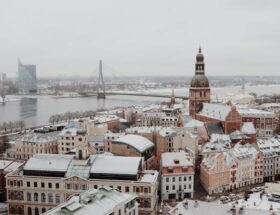
Riga lies on the wide, slow-moving River Daugava in Latvia, not far from where it meets the Baltic Sea. It sits at a natural crossroads between Northern and Eastern Europe — a position that has shaped its identity for centuries.
German merchants, Swedish rulers, the Russian Empire, and later Soviet occupation have all left visible traces. Yet modern Riga feels lighter than its history might suggest. There is space here — physically and mentally — and a sense that life moves forward without needing to erase what came before.
How do you get there?
Riga is straightforward to reach, without feeling overconnected.
- By air: Direct flights operate from London and many major European cities into Riga International Airport.
- From the airport: The city centre is around 20 minutes away. Buses run regularly, and taxis are affordable and reliable.
- By rail or bus: Riga is also well connected to neighbouring Baltic capitals, making it a natural stop on a wider regional journey.
Arrival is simple. The city does not make you work hard to enter it.

How do you get around Riga?
Riga is a city that suits slow movement.
The historic centre and surrounding neighbourhoods are compact, and much of what you’ll want to see can be reached on foot. Walking allows you to notice the details — stairwells, courtyards, façades — that give the city its texture.
For longer journeys, Riga has an efficient public transport system operated by Rīgas satiksme. This includes:
- Trams, which are particularly useful and atmospheric, running through central streets and residential areas
- Trolleybuses and buses, which connect the wider city and outer neighbourhoods
Tickets can be bought via machines, apps, or kiosks, and services are regular and reliable. Taxis and ride-hailing apps are also widely used and reasonably priced.
Riga doesn’t require a plan to navigate. It allows for improvisation.
What is there to see?
Riga doesn’t ask you to tick boxes.
It rewards wandering.
- The Old Town (Vecrīga): Cobblestone streets, medieval buildings, and small squares where history feels close rather than staged. It’s lively without being overwhelming.
- Art Nouveau districts: Riga is one of the world’s great Art Nouveau cities. Streets such as Alberta iela reveal ornate façades — faces, curves, and details that invite slow looking.
- Central Market: One of Europe’s largest markets, housed in former Zeppelin hangars. It offers a glimpse into everyday Riga — food, routine, and local rhythm.
- The river and parks: The Daugava provides openness and scale, while green parks punctuate the city and soften its edges.
Museums, galleries, and concert halls add depth, but Riga’s character often emerges between destinations rather than inside them.
When is the best time to go?
Riga changes noticeably with the seasons, and each has its own mood.
- Late spring to early autumn (May–September) is the most comfortable time to visit, with mild temperatures and long daylight hours.
- Summer brings light-filled evenings, outdoor cafés, and a relaxed atmosphere that lingers well into the night.
- Autumn feels quieter and more introspective, with softer colours and fewer visitors.
- Winter is cold and dark, but atmospheric — snow-covered streets, Christmas markets, and a slower, inward-facing pace of life.
Riga suits travellers who are willing to adapt to the season rather than expect uniform conditions.
How long should you stay?
Riga works best when you give it time to settle.
- 2–3 days is enough to see the main sights and understand the layout.
- 4–5 days allows space to slow down, explore neighbourhoods beyond the centre, and experience the city without urgency.
It’s not a place that demands a long stay — but it rewards those who linger.

What should you wear?
Riga’s style is practical, understated, and quietly considered.
- Layers are essential throughout much of the year, as weather can change quickly.
- Comfortable walking shoes are important for cobblestones and long days on foot.
- Neutral colours and simple cuts blend in easily.
- In summer, relaxed tailoring works well; in winter, warmth matters more than display, though locals still dress with care.
Nothing flashy. Nothing forced. Just clothing that functions and lasts.
Why Riga?
Riga is not a city you conquer in a weekend.
It’s a city you come to understand — slowly, through observation rather than instruction.
If you’re drawn to places that feel lived-in rather than performed, where history and everyday life sit comfortably side by side, Riga may stay with you longer than expected.
Thanks for reading and wandering with me —
GertieBlu