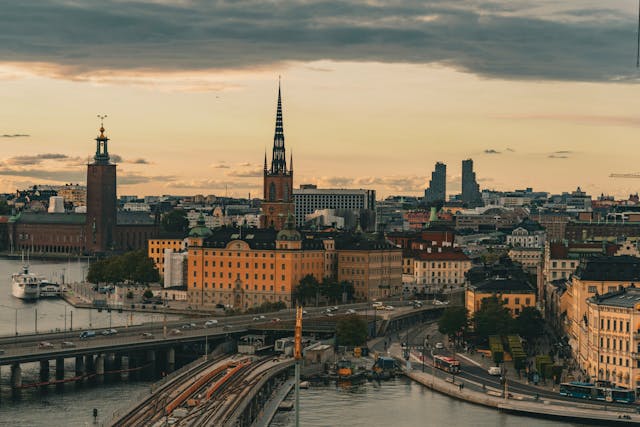
There are cities that shout for your attention, and cities that simply invite you in. Stockholm belongs firmly to the latter. Built across fourteen islands where Lake Mälaren meets the Baltic Sea, it’s a city of water, light, restraint and balance — beautiful without trying too hard, stylish without showing off.
If you’re looking for a European city that feels modern, humane, and quietly confident, Stockholm is a very good place to start.
Where Is Stockholm?
Stockholm sits on Sweden’s east coast, spread across a web of islands connected by bridges, ferries and footpaths. Water is never far away — canals, inlets and open sea shape both the geography and the rhythm of the city.
Despite being Sweden’s capital, Stockholm feels surprisingly calm. Nature is threaded right through it: forests, parks, swimming spots and open water are part of everyday life, not something reserved for weekends or escapes.
How to Get There
Getting to Stockholm is refreshingly straightforward.
- By air: Most international flights arrive at Stockholm Arlanda Airport, around 40 minutes north of the city.
- Into the city: The Arlanda Express is fast and efficient, whisking you to Stockholm Central Station in about 18 minutes.
- By train: Excellent rail links connect Stockholm with Copenhagen, Oslo and other Scandinavian cities.
- By ferry: Overnight ferries run from Helsinki, Tallinn and Riga — a relaxed and scenic way to arrive.
Once you’re there, public transport is clean, punctual and intuitive. Walking is often the best option of all.
When to Go
Stockholm changes dramatically with the seasons, and each has its own appeal.
- Late spring to early summer (May–June): Long daylight hours, blossom-filled parks, outdoor cafés returning to life.
- High summer (July–August): Warm days, cool evenings, swimming in the city, boats everywhere — this is Stockholm at its most relaxed.
- Autumn (September–October): Crisp air, golden light, fewer visitors and a more introspective mood.
- Winter (December–February): Cold, dark, atmospheric — snow-dusted streets, candlelit cafés and a very Scandinavian sense of cosiness.
If you want balance, June or early September are ideal.

What to Do in Stockholm
Stockholm isn’t a city you rush through. The best way to experience it is by slowing down, walking often, and letting water and light set the pace. Much of what makes the city special happens in the spaces between attractions.
Lose Yourself in Gamla Stan
The old town, Gamla Stan, is one of the best-preserved medieval centres in Europe. Narrow streets wind between tall, weathered buildings painted in soft yellows, reds and earth tones. It’s easy to dismiss Gamla Stan as “touristy”, but timing matters. Visit early in the morning or later in the evening and it feels quietly theatrical — footsteps echoing, shutters half closed, light pooling in the cobbles.
Small galleries, independent shops and tucked-away cafés reward curiosity. This is a place to wander without a plan.
Visit the Vasa Museum
The Vasa Museum is Stockholm’s most visited museum, and deservedly so. The Vasa was a 17th-century warship that sank on its maiden voyage, only to be recovered over 300 years later in near-perfect condition.
Standing beside it is genuinely moving. It’s not just a technical marvel — it’s a reminder of ambition, failure and human overconfidence. Even if museums aren’t usually your thing, this one stays with you.
Spend Time on Djurgården
Djurgården feels like Stockholm exhaling. This leafy island is home to museums, long walking paths, waterfront cafés and quiet stretches of green where people picnic, read, or simply sit and watch the water.
It’s an ideal place for a slow afternoon: walk, stop for coffee, walk again. In summer, the light lingers here well into the evening.
A Note on ABBA
For many visitors, Stockholm is inseparable from ABBA — and the city embraces that legacy with good humour rather than kitsch. The ABBA The Museum, located on Djurgården, is playful, interactive and surprisingly well done, even for those who wouldn’t call themselves fans. It’s less about nostalgia and more about how a small country produced one of the most globally influential pop groups of all time.
Even if you don’t go inside, ABBA’s presence hums quietly in the background of Stockholm’s cultural identity — confident, international, and unmistakably Swedish.
Take to the Water
Water isn’t decoration in Stockholm — it’s infrastructure, culture and mood. Ferries function as public transport, and boat journeys are part of daily life.
A simple harbour ferry offers a new perspective on the city, while longer trips carry you into the Stockholm archipelago — thousands of islands scattered across the Baltic. Within an hour, the city fades into red wooden houses, rocky shorelines and near-silence. It’s one of the easiest city-to-nature transitions in Europe.
Walk the Neighbourhoods
Beyond the historic centre, Stockholm reveals itself through neighbourhoods rather than landmarks.
- Södermalm is relaxed and creative, with independent shops, viewpoints, cafés and vintage stores.
- Östermalm feels more refined and residential, with broad streets and elegant buildings.
- Norrmalm is busier and more commercial, but useful as a hub.
Walking between them, often across bridges, gives a real sense of Stockholm’s scale and rhythm.
Swim, Even in the City
In warmer months, locals swim everywhere — off ladders, rocks, pontoons and public bathing spots. The water is clean enough, and swimming is treated as a normal part of city life rather than an event.
Even if you don’t swim, watching people step calmly into open water in the middle of a capital city says a lot about how Stockholm works.
Eat Simply, Drink Good Coffee
Stockholm’s food culture values quality and restraint. You’ll find excellent bakeries, thoughtful casual restaurants, and coffee taken seriously everywhere.
Fika — the Swedish ritual of coffee and something sweet — isn’t a trend here; it’s a pause built into the day. Lean into it. Sit longer than you planned. No one will rush you.
Do Less Than You Planned
Perhaps the most Stockholm thing of all is allowing time for nothing in particular. Walk without headphones. Sit by the water. Notice the light. Let the city unfold rather than perform.
Stockholm doesn’t reward urgency. It rewards attention.

How Long to Stay
- 2–3 days: Enough to see the highlights and get a feel for the city.
- 4–5 days: Ideal — time to slow down, explore neighbourhoods, and take a ferry into the archipelago.
- A week or more: Perfect if you enjoy routines, walking, swimming, and living like a local rather than ticking boxes.
Stockholm rewards unhurried travel.
What to Wear
Stockholm style is practical, minimalist and quietly confident.
- Layers are essential — the weather can shift quickly.
- Neutral colours work well: black, grey, navy, beige.
- Comfortable walking shoes are non-negotiable.
- Evenings out are understated: smart-casual rather than dressed up.
In summer, think linen shirts, light jackets and trainers.
In winter, a proper coat, scarf and waterproof boots will make all the difference.
Above all, wear things that work. Stockholm fashion is about function with taste.
Final Thoughts
Stockholm isn’t a city that overwhelms you. It settles into you slowly — through water reflections, long walks, good coffee, and a sense that life here is designed to be lived well.
If you’re craving space, clarity and a calmer rhythm — without sacrificing culture or beauty — Stockholm is quietly one of Europe’s best answers.