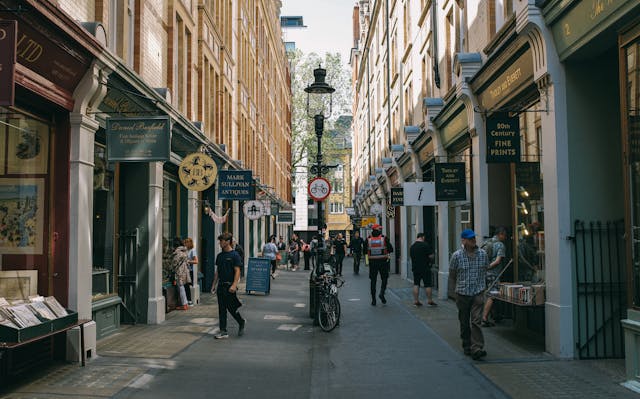
For as long as cities have existed, trade has shaped their streets.
Markets gathered beneath open skies. Stalls lined narrow lanes. Arcades offered shelter and spectacle. Department stores rose like cathedrals of consumption. The shopfront became one of the most recognisable features of urban life — glass, light, display, invitation.
Retail has always been visible.
It animates pavements. It fills windows. It gives people a reason to linger. Even those who buy nothing participate simply by passing through.
But the way we purchase goods is changing — and it is changing quickly.
Online platforms have compressed distance. Warehouses on the edges of cities are replacing storerooms in town centres. Algorithms now curate what shop windows once displayed. Convenience increasingly bypasses the high street altogether.
So what happens by 2075?
Will physical shops still exist at all?
On one level, it seems possible that many will not. Automation will improve. Delivery will accelerate. Virtual environments may allow immersive browsing from home. Artificial intelligence could anticipate needs before we articulate them.
The logic of efficiency favours digital systems.
But cities are not built solely on efficiency.
Physical shops do something beyond transaction. They create texture. They establish identity. A bakery signals morning life. A bookshop signals thoughtfulness. A tailor suggests continuity. Even a small convenience store provides familiarity — a light in the evening, a known presence.
These places are not merely economic units. They are social anchors.
If physical shops were to disappear entirely, the impact would extend beyond retail economics. Streets would quieten. Windows would darken. The act of wandering — of browsing without purpose — would fade. Cities would become more streamlined, perhaps, but also more abstract.
Shopping has long been one of the most accessible forms of public participation. You do not need to buy to belong to a high street. You simply need to walk through it.
Remove that layer, and urban life shifts.
Yet history suggests transformation rather than extinction.
Markets did not vanish when department stores arrived. Department stores did not vanish when shopping centres emerged. Each era reshaped retail to fit new technologies, new habits, new expectations.
By 2075, physical shops may be fewer, but more deliberate.
They may function as showrooms rather than stockrooms. As community spaces rather than inventory hubs. As environments for experience — workshops, tastings, gatherings — rather than shelves stacked for volume.
Routine purchases may migrate entirely online. But distinctive spaces may survive precisely because they offer what the digital cannot: presence.
Cities themselves will influence the outcome. As populations grow denser, neighbourhoods may integrate retail more seamlessly into residential life. Former large-scale commercial districts may fragment into smaller, localised clusters. What we now call “high streets” may evolve into hybrid corridors of food, culture, service, and limited retail.
The question, then, is not whether we will continue to buy things — we will.
It is whether we still value shared physical environments in which buying happens.
The deeper shift may not be about buying at all, but about ownership itself — a question explored further in Will We Own Anything in 30 Years?
By 2075, efficiency may dominate commerce. But atmosphere will still shape cities.
If physical shops endure, it will not be because they are the most convenient way to purchase goods.
It will be because they remain one of the simplest ways to give a street meaning.
And in choosing whether they survive, we may be choosing the future texture of our cities.
—
GertieBlu